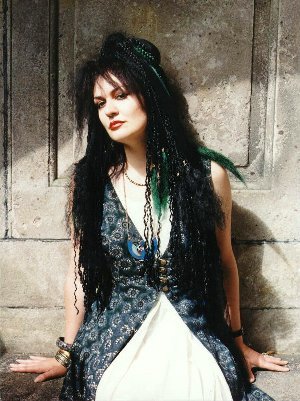
Storm Constantine was described as an award-winning author, a queen of gothic dark fantasy, and the natural successor to Mervyn Peake. To me, she was my friend for many years and an inspiration for my own creative talents.
When Storm died after a long illness, her closest friends wanted to commemorate her in a way that was fitting for such a visionary storyteller. This idea became Pashterina’s Peacocks, a tribute book celebrating her life and works, with material drawn from the memories of those who knew her best and additional fiction inspired by her creations.
As the months after she died slipped into summer, I did not know what to contribute to the book, or indeed if I would. Her closest friends were almost universally women, and, despite some of Storm’s more self-destructive flaws that would sometimes test these close friendships to beyond breaking point, these groups were vital sources connecting her to the world (weird or otherwise) outside of her writing room.
I was reading a book on writing by Margaret Atwood (one of Storm’s most cherished authors) when I came across the words that, combined with the memories of Storm’s 1994 novel Calenture, became the title and inspiration I was seeking. That is the story that, within a month of hectic writing to meet the deadline, became the final entry in the tribute to her.
For now, it remains a short story. One day, when I look back on all the time I spent in Storm’s company, I hope to return to it and expand it into the novel I believe she would have wanted to read: a worthy addition to the world her endlessly curious mind brought to life, where cities roamed the Flatlands, sheltering their inhabitants from the dangers of an ephemeral world that existed both within and beyond one man’s imagination.
Status: Published in Pashterina’s Peacocks.
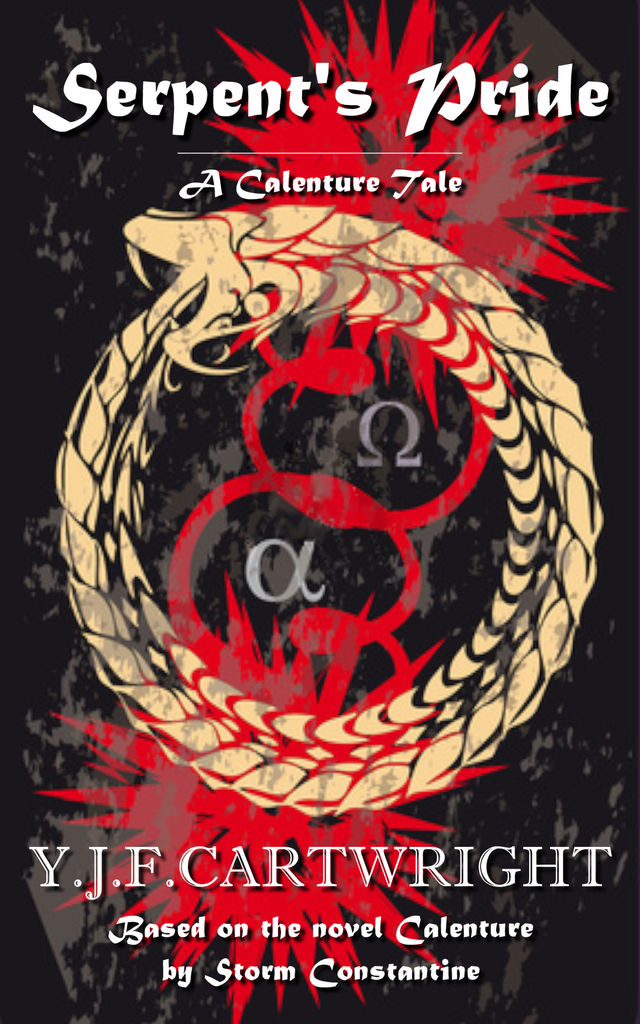

An extract version of the original short story that appeared in Pashterina’s Peacocks (Immanion Press © 2021)
Damarel
The city had stopped moving. This was no predicted terminus caused by a knot of pilot stones placed in its way by a group of terranauts. No abnormal shift had occurred to displace them in the landscape. No source of water lay close to entice the great moving metropolis nearer. Nor had the city foundered upon sharp stakes of rock, or become bogged down in an unexpected plainswash, an infrequent menace whenever the city’s path took it closer to the vast mountainous ring surrounding the Flatlands. This felt different, and Damarel thought she knew why.
It was a suspicion more than a working hypothesis, but her instincts had proven right many times before. It was how she had become a breakdown-diviner, her talent for solving the more intractable problems of the city having elevated her above the ranks of the typical engineer. Her mother, Lilane, would have been proud of her daughter’s achievements, having surpassed those of her own, but she had not been there that day when the official had arrived to deliver the good news. Barely out of her apprenticeship, Dameral had been helping her mother repair a main spar when Lilane had inexplicably decided to leap from the walkway near to the main cataract that vomited unusable fluids to the lands passing by hundreds of feet below. It had been an unfortunate accident, she had been told, a hazard of the job and not at all like the one her father had caused, which had burnt him to a cinder when she was only a child.
It had not been an accident, no matter what the Gyrean city officials told her. She had been there when her mother looked at her so strangely, with eyes so unlike hers as if she could see straight through her whilst she held up the tool her mother had asked her for. They had stood there on the walkway, locked in that strange stare for barely half a dozen heartbeats before, without a sound, her mother had turned slowly, extended her arms and swan-dived over the chain railing still clutching her favourite wrench.
Maybe it was her intangibility that had given her mother such fear, a wave of it so profound that non-existence was preferable to its touch. Damarel had first felt it when she was very small. It was her earliest memory, the sense that she was not really there, that at least part of her, the part that was the most real, was somehow somewhere else, barely connected and fragile.
She had first voiced her concerns to her parents on the day of her eighth birthday when she finally had the words to express them. Her mother had laughed as she tried to get her to sit still, combing out the knots in her chestnut curls ready for the celebratory gathering of friends. In stark contrast to his wife, Mirrit had not laughed at such a childish notion. He’d remained standing in the doorway of her room, looking at her almost suspiciously before the first arrival to the festivities interrupted his thoughts. He hadn’t lived to see her ninth birthday.
With both parents gone, her life as an orphan had begun too young, the wellspring of her soul poisoned by loss and the taint of unreality, and whilst these feelings came in waves as the years slowly rolled by, as she grew, their intensity only increased.
On the day the city became marooned, Damarel had been tasked with solving an intermittent problem with one of the main crankshafts that fed the myriad movement mechanisms that propelled the city endlessly over the landscape. Gyre was not an old city, not compared to others of a similar size, but it had developed fast from the primordial citykin that had launched upon the lands with such new ideas.
Unlike most such hamlets, the original masterplan for the city had not evolved from those grand dames that had tracked across the Flatlands for countless centuries. Gyre was to be unique, its very heart giving the city its name. All of its motion was to come from the movement of the air itself. In its smallest state, rotating sails provided the initial force that first drove the ramshackle huddle of buildings onwards. After came the airvanes and airscrews that allowed the emerging city to develop and grow rapidly.
As their experience of harnessing the wind grew, the pioneering philosopher-scientists who had first begun construction conjured new devices: vortex tunnels and aerogenerators augmented the emerging city’s towers, windstalks and spiralcatchers stretched into the sky, swaying like tall grasses in the breezes or spinning in the sunlight. On the two-hundredth anniversary of its founding, miles-long windladders were launched, snaking high into the atmosphere, trailing their multicoloured kites in the city’s wake. These moved in an endless cycle as their foils first lofted them high before angling to enable them to descend once more, all the while taking advantage of the ubiquitous high winds unavailable nearer the ground, their looped cables constantly turning turbines night and day.
Within a few generations, the city had become thousands-strong, helped by an influx of curious minds normally shunned by the inhabitants of the other insular cities. Gyre’s maturing parts had been broken apart many times over the years with every new advance, either demolished, migrated out to its rim or built over. In time, a cyclopean new centre with gigantic twin animal-like fins had emerged. These were sculpted to channel the wind flowing between them into a vast air dam, its great spanning sail funnelling the accelerated air into a huge turbine, the largest by far in the city. From here, the energy was transmitted through uncountable gears, axles, cogs and chains down through the very strata of the city, feeding its dark underbelly of wheels, rollers, stickwalkers, paddles and skis. All other cities could claim a lineage of ideas that propelled them forth; but aside from the fabled floating city of Min, Gyre remained the only true original. Now, for no reason, it was static in the world, the greatest fear of all city-dwellers.
To be stationary on the Flatlands invited grave danger. This came in many forms, but primary amongst them was the threat from other cities. Having a fixed location meant being easily hunted or harried by any roaming hostile city or other group intent on pillage or destruction, with no hope of evasion and little respite. Why the cities had started to move was a mystery. Perhaps it had been a great war or some form of plague that had only affected those close to the surface. Whatever it had been, there were no records of the cataclysmic events. No one from the ancient civilisations of the Flatlands wanted future generations to know their pain, the memory of the devastation, the near extinction. Now, combined with resources stretched thinly across the undulating plains, no large, static city could ever hope to survive for long.
With a suddenness in keeping with the lurching halt, teams of engineers were hastily dispatched into the rigging that underslung Gyre that allowed for inspection and any necessary repairs. Wheels were examined, lubricants and hydraulic fluids checked, changed or reapplied, and all of the bearings on the giant rollers were inspected for cracks or stubborn debris. Even the reticulated stickwalkers were given a thorough assessment, although none could say why any fault in them would have led to the city’s stubbornness to move. Nothing they did made any difference as they worked in droves into the night.
“I was worried about you,” said Joh, as she lay in her lover’s arms.
The bunk was barely wide enough for the two of them, designed as it was for a shift worker. Damarel gazed into Joh’s liquid-blue eyes and saw the fear for herself. If it hadn’t been for the increasingly desperate situation, they wouldn’t have had the opportunity for a liaison in the corridor-like barracks. By chance, all of the other engineers in the cabin were out tending to Gyre’s woes, and they had found themselves alone. Damarel’s own lodgings were somewhat less basic and certainly more private. They were also in one of the oldest parts of the city that had earned it the name The Ramshackles from soon after the first great redevelopment. With Joh’s next emergency shift imminent, they were also too far away.
“I’m fine,” replied Damarel, lying as convincingly as she could. “I wasn’t on the walkways when the city stopped.” Physically, she was fine but inside her mind was a shadow of a returning fear that had been temporarily quelled by Joh’s anxious lovemaking.
Joh’s words were deliberately muted even though they were alone. “Several mechanics fell to their deaths,” she said, not wanting to voice her fears aloud.
“Hush, my love,” soothed Damarel, kissing her lover’s mouth and forehead, smelling the scent of citrine from their communal shower. “The city will be moving again soon.”
There was fear in Joh’s eyes as she spoke. “But why has it stopped? It’s not old.”
The same question had barely left Damarel’s thoughts. “I don’t know. Maybe it is the opposite problem? Some of the machinery is still quite new, so there’s bound to be some teething issues. Even the parts we are familiar with we can’t be sure how long they’re supposed to last for.”
This was true, and the uniqueness of Gyre’s various novel propulsion systems had been causing problems for the city’s engineers for generations. It was a grand experiment begun years before by a group of long-dead philosopher-scientists who had left their original city, a city whose name and history were both lost and irrelevant. The people they’d left behind must have believed them mazey-minded to even consider leaving the safety of their original home city, to start again from nothing, but their plan was easier and quicker to achieve from a blank slate. Revolution was like that.
“Do you get a sense of anything?” asked Joh hopefully.
Damarel thought for a moment, her fingers lightly stroking Joh’s raven hair. “No,” she lied again, “but we will find the answer. Now rest. Tomorrow may be a long day.”
How could she worry Joh further? She would think she was as mad as the calentured. How could she explain that she thought that she had somehow infected Gyre with her intangibility? As Joh’s breathing slowed, she thought through the events of the day, unable to quiet her mind.
The morning had started as a completely ordinary day. She had diligently worked on her assigned task, tending to the ministries of one of the city’s many massive crankshafts, trying to understand what might be causing the huge device to stick fast whilst the manifold machinery elsewhere kept Gyre moving at a steady slow walking pace. To diagnose the errant issue meant testing all the various parts, the rods, webs, journals, crankpins, counterweights, dampeners and flywheels, ensuring sufficient vegetable oil could reach it all from the passageways unimpeded, never too hot or too cold, to be as efficient and trouble-free as possible. Hours had passed, and nothing appeared capable of generating the anomaly.
In her mind’s eye, she could picture the integrated machinery moving, turning, sliding, pushing; the sheer complexity of the interconnected whole that began even above the highest parts of the city, transmitting down to propel Gyre wherever across the Flatlands its city-soul decreed. Her ability to hold the abstract and dynamic nature of the city’s inner workings in her mind had made Damarel the youngest breakdown-diviner in Gyre’s history, and certainly the most promising one for generations. She turned the model over in her mind, trying to see all of the angles, working backwards from the problem before her. So ingenious was Gyre’s design and intricate implementation that it was hard to believe that any part of it could ever fail so completely.
That was when a thought struck her: what if the city itself, or some force beyond its lofty borders, wanted it to fail? Maybe it was her fault. Was Gyre like her mother? The more she grew into the world, the more she explored and diagnosed Gyre’s inner workings, the more her intangibility spread to those beyond her, perhaps into the very heart of the city itself. What would happen if the city felt thin, as she did at times? Maybe its reality was somehow insubstantial or unreal, an invention of an inventive mind? What if they now both were? That was the moment when Gyre halted.
The next day brought more uncertainty and a growing sense of dread that pervaded down from the metal and glass fins that sliced through the city’s hub and into the dwellings of the Gyreans. As Damarel and Joh got breakfast from the barrack’s canteen, all talk was of the immobile city. Just down from their bench, two engineers were having a discussion that was turning heated.
“No, you’re wrong!” exclaimed one of the men, banging his spoon on the wooden surface.
“I’m telling you, there’s a bad air in this area,” replied his companion, shrugging his shoulders. “We just need a strong mountain wind to clear it.”
Joh glanced at Damarel, who furrowed her brow in response but said nothing. “If that’s true,” started Joh, “then couldn’t we just rig some of the larger airscrews in reverse, focus them back into the air as a disperser?”
Damarel shook her head. As powerful as the airscrews were, they were dwarfed by the sheer size of Gyre. “Unfortunately, that wouldn’t be anywhere near enough,” she said to those around her. A thought did occur to her, though. If bad air really was the problem, there could be another way to achieve Joh’s idea. “Of course, if that was the aim then you’d be better off using the air dam to pulse waves of air over the city.”
That made several engineers nearby stop eating, their thoughts tuning into Damarel’s fledgling plan. One was even smiling. Was that a good sign?
“That’s an interesting idea,” spoke up one engineer with butternut soup in his beard.
“Yeah, but how would you direct it?” asked a woman with short flame-red hair, her fringe failing to completely hide a thin scar across her forehead. It was a mark of the profession, and the experience of the engineer often was judged on the number of such scars. Damarel herself had several, the most prominent of which was a slash across her left shoulder caused by getting too close to a spiralcatcher she thought she’d disengaged.
“The city will move when it wants to,” interrupted one of the older mechanics to no one as he stared into his broth. This voice was Terryk’s. Everybody knew and respected Terryk. He’d been an engineer for over sixty years and had done pretty much every mechanical job in the city in that time. Kinemechanic, megafacturer, ferrumer, aerorigger, even a few years in residuals.
“And we will help it,” said a voice from behind Damarel. She hadn’t noticed the arrival of Hirun, her chief breakdown-diviner and wondered if she was late for her shift. Twisting her body to face the man, she was relieved to see that he was carrying his breakfast. “This isn’t the first time Gyre has stopped unexpectedly,” he stated with some reassurance to his fellow engineers.
Damarel was pretty sure that it was having reviewed the scant information about Gyre’s history in the city library. She wondered how Hirun could be so sure of his statement but decided against questioning her superior in such a public place. With their own breakfast finished, she got up to leave with Joh following suit, allowing Hirun to take her place. The febrile atmosphere of the canteen lifted as they exited onto the busy streets of the Chord District. Even outside, though, the usual good cheer of Lever Crescent was subdued. People seemed to lack their usual enthusiasm for a new day, either trudging disconsolately on their journey or simply sitting on one of the street benches, their faces melancholic and drawn with worry. As they made their way through to their designated sites for the day, Damarel and Joh could not fail to overhear the brief snatches of street chatter concerning the city’s woes.
“But what are we supposed to do?”
“Leave it to the engineers,” said his male companion, pointing at Damarel and Joh as they walked past. “They’ll sort it.”
“Gyre is dead!” exclaimed one man dressed in black to a group of people standing in an arc in front of him. “We just don’t want to accept it!”
“If it is, where would we even go?” asked one woman of her friend who looked as forlorn as she did as they listened to the doom-monger.
Damarel quickened her pace, not wanting to linger near such talk. At the entrance door that led to a service walkway, she kissed Joh, imploring her to take extra care before leaving her lover for her latest crisis shift. She would need to begin her own soon but, before then, she had a sudden urge to head past her lodgings in the Ramshackles to the edge of Gyre.
There were fewer people around than normal. Usually, landseers enjoyed the views over the oncoming terrain, delighting in the new sights to come and any opportunities they might hold. Not this day. Most people were deliberately keeping clear of the walled rim, only in part in case the city was to suddenly move, risking the unwary pitching over the edge. Damarel, however, could guess the unspoken reason: looking out over the exact same landscape features and their unchanging relative positions was a visceral reminder of the citizens’ approaching doom.
Movement through the Flatlands meant more than simply growth and prosperity; it was a way to acquire whatever the city needed; it was survival itself. Only the terranauts truly thrived in the Flatlands. Their nomadic peoples were held in an admixture of awe and suspicion by most city folk. They alone knew the secrets of the pilot-stones that guided the cities in their meanderings but could give no reason as to why they set lines of them across the landscape. Many in the cities thought of them as mad. It wasn’t unheard of for rogue terranaut bands to occasionally wreck cities by leading them into traps of watery expanses or great seas of sand. Why they did this, none could say. The city-dwellers believed themselves to be metaphorically and literally above the terranauts in every way, but the truth of their semi-parasitic relationship with the land travellers could never truly be forgotten. Had their distant ancestors all been terranauts at one point before some schism or great cataclysm forced them skywards? It was a group of terranauts that had emerged from the soft morning light who now joined their efforts to overcome the city’s inertia.
As a child, Damarel had always thought that each terranaut troupe must be quite different from each other given their small constituent numbers, but it was only when she was older that she realised how isolating each city was from all others, with very little interaction over the generations. Unlike the free-roaming terranauts, the city dwellers didn’t just live in walled gardens; they existed almost entirely within closed ecosystems, their development driven from within, whose original seeds were sown by the disparate minds of philosopher-scientists intent on new thinking, not common ways. All the cities’ inhabitants really shared was a language and an existential dread for what would happen without those walls and the movement. The movement was everything, that constantly changing vista.
From one of the main walkways gilding the underside of Gyre, engineers of various talents stared down at the approaching terranauts whilst mechanics busied themselves in the rigging. Damarel was in the group descending one of the walkways to the ground, her team’s talents the main hope for the city’s inhabitants. It was strange to see Gyre from the Flatlands’ surface. It was, she realised with some incredulity, the only time in her life she ever had. Even the air smelled different, like the earth had been burned long ago or formed from fire but now only held the faintest residue of this great conflagration. Looking up through the bright sunlight, she shuddered at the sight of the great array of movers, static, silent, lifeless. Quickly, she withdrew her anxious gaze to focus on the unusual group in front of her.
She’d met only two terranauts in her short life, both of them apparently typical of their kind, driven by a carefree wanderlust, hedonistic outlook and a somewhat capricious nature that made them greatly fascinating to the staid city-dwellers. The first was when she was quite small. Her only memories of the man were him showing her a gleaming pilot-stone fragment set into one of his teeth, its surface glinting amber in the firelight from her parent’s hearth. The second terranaut was a woman, Vela, a free soul and her first intimate who spoke of living on the vast plains, steering cities with stones, trading with their populations, experiencing all those different cultures that emerged in isolation within their roaming walls.
Damarel had hoped to keep the exotic woman within Gyre for longer, using her body in newfound ways to barter more time to absorb as much as she could about life beyond the confines of the city. Their mutual attraction, though, was insufficient to overcome the older woman’s roving spirit. Before the next new moon, Vela was gone, leaving an emotional, physical and ontological void in her wake. There were answers out there in the world, Damarel was sure of it, to questions that had plagued her since childhood, about the origins of the first cities, the mysteries of the great mountain ring at the ends of the earth, perhaps even to her growing feelings of semi-existence.
No two cities were alike, their peoples evolving in relative isolation behind their walls with different customs, cultures, traditions and conduct with other Flatlanders. In contrast, most terranauts were surprisingly similar given their nomadic existence. It was understandable that when the two groups met, there would be mistrust. It was Hirun who first spoke to the group of terranauts, greeting them in the traditional way.
“Hail fellow travellers of the land. What can you tell us?”
A tall woman with long, close-curled blonde hair that splayed over her shoulders and tumbled down to her waist approached. “I am Embar. I lead this troupe.” Embar gestured with long, delicate fingers at the front of the city. “We saw your city stationary against the sky and came to determine why. The stones are laid out correctly, and none are damaged. We have tried replacing those closest before you, but there is no change.”
“Could it be bad air?” spoke up Damarel, still wondering if such a thing was even possible. There was a derisive snort from a young terranaut male who had a gold ring in his ear. “Or what about other disrupting influences?” she continued, willing her face not to redden.
There was a momentary pause as the woman appeared to be trying to discern the hierarchy amongst this city’s engineers. “From other terranauts?” queried Embar.
Damarel felt all eyes upon her. “Maybe, but I was wondering if something external to the city, other than the pilot-stones could exert some kind of controlling force,” she glanced nervously around the terranauts, suddenly self-conscious in a way she’d never felt before, “or the city itself had chosen to remain here?”
Embar stared down at the peculiar young woman. “If this was terranaut work, we would know it.”
Damarel pressed further, following her instincts. “Have you heard of anything other than the stones that could halt a city?”
Embar flicked her eyes between the assembled terranauts and the citizens, two peoples connected by the great cities. “Sometimes cities choose to end.”
“End?” queried Hirun, unsure of what the woman meant.
“Yes,” nodded Embar. “We do not know why.” She looked over the landscape, taking in the vast swathe of city strata before her that eclipsed much of the sky. “Maybe they have simply experienced the Flatlands for too long? Some think they grow tired of their own existence or grow too much, become too complex and break.”
“We would be able to fix such an occurrence,” stated Hirun somewhat haughtily.
“If you say so,” replied Embar dispassionately. “Cities are wrought from the land, displaced from it.” The terranaut fixed the chief breakdown-diviner with eyes as empty as a vacant grave. “They will return to it.”
“What would make a city want to end?” asked Damarel. Her thoughts went back to the moments before the city shuddered to a stop. Could this all really somehow be her fault?
“None can say for sure. Maybe over time, the shifts take their toll. As we travel, we sometimes see the lit-less corpses of their constructions.”
Damarel felt nauseous. Was Gyre’s malady a systemic problem? Everyone knew that it was the terranauts that caused the shifts that periodically affected the world, causing changes in time and space, energy and matter. Why they did this, they would never say, but perhaps there were other ways to trigger them? Either way, no engineer she was aware of had ever linked them to disasters on such a scale. All citizens learned from a young age to stay still during a shift when it occurred, accepting any changes to their consensual reality once the unnerving event had passed. Clearly, it appeared that the shifts had nothing to do with the city’s current predicament, and one had not occurred when the city abruptly stopped.
Whatever this event was, it was new and of a different cause than anything the current city’s engineers had ever been tasked to solve. Had this event, or something like it, happened before in the Gyrean creators’ former home, wherever that had been? Was this why she had found so little information in the city’s archives that spoke of those first years and what may have come before?
Damarel almost didn’t dare to ask the question everyone must have been thinking. “What happens to their citizens?”
“They abandon their homes and go into the Flatlands,” replied Embar simply, without any obvious compassion. “Most die. Some find other places to exist, other cities sometimes. Few stay as travellers on the land.”
Damarel could not conceive of ever leaving Gyre. The thought of being adrift on the plains with no city for protection or nourishment was unbearable.
“Can we offer the city another route?” asked Hirun. “Gyre has passed over many intersecting lines of stones in its past, sometimes moving onto a different path.”
Embar considered the idea. “I do not know if this has been done with a city that has been stilled.” She looked around at the older members of her troupe, but none suggested otherwise.
“But we can try?” entreated one of the engineers.
“We can,” emphasised Embar pointedly.
For the rest of the day, the terranauts toiled beneath the great disc of the city, their work made more difficult by the implacable presence of the disjointed movement array. Shortly before dusk, Embar announced that their work was done. The city would either move or it would not, and nothing more they did could change its fate.
“We thank you for your efforts,” said Hirun to the terranauts, “and would like to give you something in return. Perhaps you would like to see what Gyre offers?” He looked across his team of engineers. “I’m sure we can find suitable recompense for your efforts today?”
The terranaut leader looked at him through stony eyes. “We will not go into the city,” stated Embar flatly.
“Why not?” asked Hirun with some surprise. Gyre had hosted its fair share of terranauts in its time, mostly those on one of their enforced solo wanderings, but occasionally larger groups had climbed the visitor walkway and travelled the conveyor belts that led into the market area.
“Not all cities lie still when their end comes. Some undergo death throes,” warned Embar, her eyes glinting in the light of the dying sun.
The group of engineers exchanged nervous glances. They had all heard tales of other cities, ones whose end came abruptly. The tales were fanciful and told by plains-travellers in exchange for a meal or a drink at the many inns in the city. They were stories for the gullible or those of limited intellect but, in Gyre’s long travels, evidence of past catastrophes was infrequently chanced upon; wrecks of failed city-forming endeavours, the crushed remains of collapsed city-sections, the occasionally solitary wheel, crawler track or roller enigmatically positioned on the landscape, a discarded sentinel of a long-lost or now-distant city-culture.
“But Gyre is young!” pleaded Damarel.
Embar bent down at her with a sympathy reminiscent of her mother’s. “If the city will not move, be sure to leave while you still can.” The terranaut returned to her stiff pose as she addressed Hirun. “We will accept nothing while the city remains here, nor will we linger for long.”
The group of engineers looked aghast. Was there so little time? The thought that they would fail was anathema to their very being. Without the city, what were they?
With that pronouncement, the terranaut troupe removed themselves in the direction of a distant copse of trees. Damarel followed the small team of breakdown-diviners back up the service walkway, trying and failing to imagine the city tearing itself apart in its premature demise. Before losing view of the terranauts, Damarel turned to see them setting up camp in the trees around a central fire whose smoke was already lost above the city’s rim. She wondered what the older members of the troupe had seen on their travels, what they knew about cities that she did not. For its constant migration, Gyre favoured the lines of pilot-stones that kept it close to the mountainous ring where the winds were stronger, feeding its heart, gorging on the air. Who knew how much more there was to the Flatlands beyond, or if there was more to the great mountains than just walls of impassable rock that stretched into the clouds?
As she lay in her own bed willing the city to move, or at least display some sign of wanting to, Damarel realised for the first time that her whole experience of life existed entirely within a thin grassy ring, a littoral sea of green and yellow encircled by an impenetrable ring of rock. Was this why she felt incomplete in her reality? Would she only feel whole or substantial if she ventured beyond her small world, filling the spaces in her mind and body? Even if that was true, would her leaving allow the city to heal in time? The mere thought of it filled her with dread. Only the mazed or the exiled left their city for any length of time. What were the chances of ever finding home again, of seeing their families and friends? It was nonsense, surely? Her mother had said so; the same woman that had, without explanation or warning, thrown herself from the only city she’d ever known, her body crushed and lost under the wheels she had worked to maintain her whole life.
No, they would get Gyre moving again! Embar’s talk of cities destroying themselves was probably a ploy to get the citizens to leave if the worst came and they had to abandon Gyre. The terranauts would then be able to strip the city of anything they needed unimpeded. Had they truly tried to help the Gyreans today, or was it all an act? What if they’d been the ones to immobilise the city in the first place, setting up an elaborate trap of pilot-stones, some confused arrangement that now lay hidden under Gyre’s movers? Embar hadn’t wanted any help, not that the city’s engineers knew how to give it, but equally the terranauts had wanted to work without any oversight. What had they actually been doing all day?
That night, Damarel’s dreams were filled with visions of the city empty, centuries of untended streets, buildings that had fallen into disrepair or worse, trees split through roofs, waterways green and stagnant. She felt utterly alone and responsible. It was eerie wandering there, the presence of Gyre absent, its heart dead. As she walked through the deserted districts, the recognisable streets and buildings from her youth morphed into those of another place, far away, a city that had never moved, its outer walls surrounded by high mountaintops like bright sparks edged in snow. This place had also been long deserted, its wan light an ashen grey, but it had not fallen into disorder to be reclaimed by the harsh world. Instead, it appeared to be preserved as if in amber, frozen at the pinnacle of its glory.
As she ventured around corners and under archways, architectures shifted, so many different styles, a mix of ancient and contemporary forms, a fusion that could never have developed within a single city on the Flatlands. Beyond a row of homes whose continuous eaves silhouetted it against the sky, she turned into a wide thoroughfare bounded by shops that led to what appeared to be a theatre wrought in white marble. She stopped abruptly, thinking she was about to run into another woman who appeared to be inspecting something in a window.
Damarel opened her mouth to apologise before pausing. The other woman said nothing, nor did she even react to Damarel as she waved her hand in front of her face. Confused, Damarel flicked her eyes around the wide boulevard. Other figures dotted the pavements, all frozen in their everyday pursuits. On closer inspection, the woman she had almost barged into turned out to be an elaborate statue carved from some form of crystal, her scrutinising pose rendered so life-like by a skilled hand. She could have been real, so detailed was the surface of her skin, the delicate fronds of her hair, her eyes jewel-like and deep, but there was no life within.
A cold dagger coursed down Damarel’s spine. Was she like this poor woman, her own fate to become as stilled as a crystal statue, just like the city? As fear gripped her, she forced herself past the woman, trying not to catch sight of the unblinking eyes that watched her passage and broke quickly into a run. She fled the street down a twisting alleyway, past the shattered remains of other people. Her foot suddenly skidded on the perfectly cleaved crystal face of a child. She screamed as she fell towards the cobbles, her face striking their shoe-smoothed surface. Lying prone on the ground, stunned by her fall, she felt another presence nearby, the hint of a mind, the mind of a man.
Damarel woke in her own bed, tears in her eyes, their salt-lines staining her pillow. Where was she? The white walls around her, the small tapestry of a wind-train weaving through a lush valley, the delicate vase containing vivid columbines on a small table near the only window, even the bed itself, none of it she could immediately recall. Her heart still thumped in her chest. The dream had felt so real, more real than the room she was in, the dreamscape’s solidity greater than the sum of her surroundings. She could still feel the chilled mountain air on her face, the iron-rich taste of dirt and blood in her mouth, the scent of wintersweet masking that of the bell-shaped flowers Joh had given her. She looked at the gift as reality subsumed her mind; the flowers were to remind her of the sky whilst she toiled in the belly of the city. The dream imagery and sensations faded fast, and the walls of her bedroom subsumed her thoughts.
From Unwen’s Tower outside, its clock chords sounded, the jaunty peal yielding to a staccato of sharp trills. With shock, Damarel realised that she’d overslept with little time remaining to see Joh, who must have been wondering where she was. Hurriedly, she dressed in her blue overalls, stuck on a protective cap to hide her unbrushed hair, barely pausing to grab her tool pouch from the table on her way out of the door. She ran through the Artificer’s Quarter, passed the Guild Hall and down on through the narrow, cobbled cut-through that led to The Lost Compass, her favourite inn, all the while trying to stymie the recurring flashes of her dream. In the Crescent, she dashed inside Joh’s section of the barracks, pushed her way through the bodies comprising the shift change and threw the door open to the cabin containing Joh’s bunk. The berth where she’d shared many stolen moments of passion in their six months together was empty. Her lover had already left for her duties that day.
For Damarel, missing out on seeing Joh was just the start of a bad day. Not only had the city manifestly failed to budge a single inch in any direction, but the increasing stress on the engineers was beginning to take its toll. Sleep for the strained workers had been snatched, when possible, but it held no succour. The city’s officials now made hourly inspections, wanting the latest news on any progress or updates on backup plans that were now in operation. This was keeping Hirun occupied away from his team just when his experience was needed the most. Even the populace itself breathed tension as if the air that hung over Gyre was thick with crisis.
As she made her way through the lower levels, news reached her that several mechanics had been assaulted during a much-needed break, as if it were possible that they were somehow lacking in their endeavours or were at fault. There had even been a public demonstration at the lack of movement, the first Damarel had ever heard of.
Despite her labours, the hours passed fruitlessly. She’d been busy burrowing her way through the inner workings of more movement systems and their interconnections than she’d ever thought possible. Monumental mechanisms both new and ancient were woven into a vast network to allow the city to progress across the Flatlands, and still no one could deduce whether the problem had been brewing for centuries. Was it an imperceptible flaw that had grown systematically, or was it a fault in the constructions of newer technologies, perhaps one innovation too far?
She’d lost all sense of time, going further inside the more ancient areas of the city, losing herself inside a nexus of gears, armatures and torsion bars when, without expectation as her mind drifted in its own thoughts, she chanced upon what she thought must be the problem.
Above a massive twisting spar, twice as wide as she was tall, only one of several such momentum shifters connected to the surface, was a void. The gap was a palpable discrepancy amongst such god-like order surrounding it. Dameral was so shocked that she could do nothing but stare into the space in astonishment. She could barely move as she felt her heart thud in her chest. Her mind screamed at her; it couldn’t be! The giant gearing that had to be attached to the high vaults was absent.
Nobody could have stolen it; that would be too large an undertaking for anyone outside a large team of specialist city mechanics, and what would possess anyone to want to, so dependent was the movement of the city to its inhabitants? No outsiders could have removed it either, as none had access to such an important location. It was only as an afterthought that she’d requested that morning to inspect each similar colossal contraption herself, despite them being one of the first mechanisms to be checked over by the city’s corps of engineers.
It was impossible. Was this why Gyre had stopped, affronted by such a reckless action, a surgical intervention into its daily routine, a theft or wanton act of destruction on a scale unprecedented? Certainly, there were enough supplementary movement systems to allow for the city to move, if it wanted to. With a fundamental part of itself gone, was it simply that Gyre was angry?
In her confusion at the quandary above her, Damarel cast her eyes around the space holding the vast segment. The only prosaic solution she could conjure for the missing apparatus involved a catastrophic failure of the gearing mechanism itself, an event so calamitous that the gearing must have sheared off so abruptly and completely to have then exploded into a thousand shards, now scattered somewhere beyond where she was standing.
Damarel shone her torch in slow, wide arcs across the dark recesses of the chamber, but nothing, not even a single metallic splinter littered the tiered floor; it was as smooth and untouched as it must have been when it was first sealed away by the early generations. In bewilderment, she returned the torch beam up to the missing gearing and her heart stopped. There was the faintest gossamer-like outline of a gear, its form only vaguely substantial due to the multitude of teeth cut with such precision into its rim. She’d heard ghost stories in her childhood, her fears falling away as her understanding of the world increased, but never once had she heard of ghost machines.
It wasn’t real. It couldn’t be. The gear, and its connected brethren, could not be disappeared yet visible, both existing and not. If such a thing was possible, then why here and not in any other part of the city or its citizens who were as much a part of Gyre as anything else? Why not her, she realised with dread, her stomach suddenly queasy, her spine like ice. Had she finally found a clue as to her feelings of non-presence? Was the ghost-gear akin to what her mother had seen moments before killing herself, unable to face the existential truth as she gazed upon her phasing daughter?
Damarel dropped her torch. Its light was snuffed out in an instant, smothering her in an inky darkness blacker than any night. When she finally felt its firm surface, relieved that it too hadn’t become incorporeal, she flicked it on and aimed it pointedly back at the spectral phenomenon. The gearing had returned. No longer was it as substantial as a light beam caught in dust; now it was fully formed, as solid and shiny as the day it had been cast.
She stared open-mouthed at the reformed mechanism, unsure of what to do next. She couldn’t tell anyone. Who would believe her? Given the circumstances, there was more chance that there was something wrong with her. It was, after all, the simplest explanation for what she had seen. Maybe it was the lack of sleep, her sheer exhaustion that had fooled her mind into thinking that the gearing had somehow phased out of the world and back in again? It was just an artefact of her own disconnection with the world made manifest by stress. There was one person she could tell, however, someone she hoped would believe her.
The complete short story is available in Pashterina’s Peacocks published by Immanion Press.